


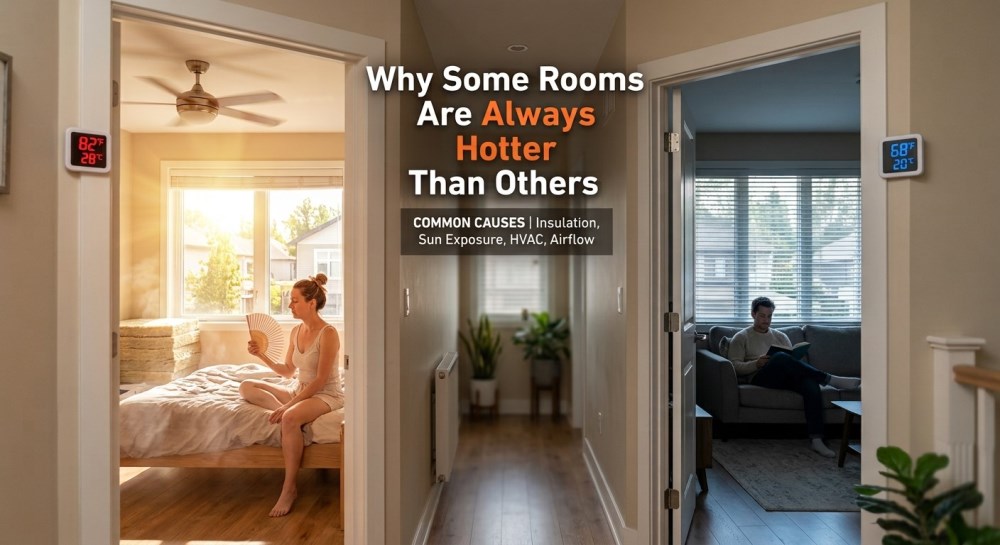


There are few things that are more annoying than setting your home’s thermostat to your ideal temperature to later discover that one specific room always feel like an absolute sauna as the rest of the house is comfortable.
This common uneven temperature dilemma occurs in households all across the country, and it’s important for homeowners to understand that these aren’t property quirks that you simply have to accept. In a lot of scenarios, there’s a specific reason why one room is hotter than another—and it usually comes down to your AC system’s airflow, your home’s insulation or your windows.
We recently interviewed a group of renowned AC repair techs in Denver, Colorado from Apex Clean Air to understand the common causes of abnormally warm rooms in order to help you know when you need professional repairs, a maintenance adjustment, or a simple change in your home’s airflow.
So, check out the below sections to see what exactly might be causing some rooms in your home to always be hotter than others!
Your Home’s Layout Can Impact Room Temperatures
Your home’s overall design can play a substantial role in how evenly it cools down on hot summer days.
For example, open-concept floorplans can allow conditioned air to freely move between connected spaces; however, homes with numerous hallways, closed doors, and rooms can experience more challenging airflow.
Two-story homes are particularly susceptible to noticeably temperature differences between floors, and this has a lot to do with warm air naturally rising upstairs and making rooms feel warmer in the summer. The rooms that are located furthest from your HVAC equipment could also receive less AC as compared to other closer spaces.
This doesn’t necessarily mean there’s some kind of architectural flaw in your home’s design, because it actually insinuates that your HVAC system needs to be reconfigured or simply properly sized to serve your specific layout.
Added Indoor Heat From Windows
It’s obvious how large windows make rooms more inviting and brighter, but they also can contribute to significant heat gain.
Rooms with west or south-facing windows are often considerably warmer during the afternoons when sunlight enters the space. Inefficient and older windows can also exacerbate these issues even more by allowing afternoon heat to seep through the glass.
Shades, window treatments, blinds, and curtains all go a long way to reduce the amount of direct sunlight that enters a room; however, it’s important for homeowners to test out their rooms with large windows because other factors could be contributing to abnormal warmth when the windows are fully covered and the space is still hot.
Rooms Become Harder To Cool Due To Poor Insulation
Insulation helps slow down heat transfers between the outdoors and your home, which means that outside heat can unfortunately makes its way inside when a room doesn’t have adequate insulation.
This is particularly noticeable in rooms located near exterior walls or just below attics. Insulation is typically the next common culprit when it’s found that a room has adequate airflow but is still consistently hotter than surrounding spaces, and improving your insulation will regulate indoor temperatures and reduce your AC system’s overall workload.
Airflow Problems
It’s also possible that your abnormal room temperatures aren’t the result of your AC system not producing enough cool air, because the problem could be getting cool air where it’s actually supposed to go.
Closed or blocked vents will always restrict airflow, and dirty filters are another common cause of HVAC inefficiencies that impact AC circulation throughout a home. Your property’s ductwork can also create more issues, which involves the following common problems:
- Poor design
- Leaks
- Insufficient duct sizing
- Damaged ducts
If one of your rooms is consistently experiencing weak airflow as compared to the rest of your home, it’s a good idea to get your ductwork system professionally evaluated to better understand what might be occurring behind your walls.
You Need An AC Repair Appointment
Uneven home cooling is sometimes a red flag warning sign that your AC system is malfunctioning.
This could be the result of a refrigerant problem, restricted airflow, dirty coils, failing electrical components, or other mechanical issues that directly impact your system’s ability to effectively cool your home. In some scenarios, your system might continuous run even while failing to actually deliver your expected cooling amounts.
If you’re currently noticing that your home isn’t cooling as it’s supposed to, professional AC repair services could be your best option to get to the bottom of the dilemma.
Your Thermostat’s Location Matters
It’s important to remember that your AC system’s thermostat doesn’t always know what exactly is happening in every room of your home.
For example, if it’s located in a naturally cool room or hallway, it might reach a desired temperature much faster as compared to warmer areas that end up constantly playing catch up. This could lead to the system shutting itself off, even though other parts of your home are still feeling uncomfortable.
Thermostat placement ends up being an essential factor to keep in mind when you’re dealing with inconsistent temperatures, and this is particularly important for homes experiencing temperature differences between floors and rooms.
Never Ignore Consistent Indoor Temperature Differences
Although it’s normal for rooms to have minor temperature differences between each other, significant or noticeably worsening temperature differences always deserve proper and prompt attention.
You should start by making simple checkups for things like blocked vents, clogged air filters, window coverings and thermostat settings. If these DIY checks don’t solve the temperature difference, you’ll likely need an HVAC professional to properly evaluate your ductwork, airflow, insulation and overall AC performance.
The goal isn’t necessarily to make one uncomfortable room cool again, because it’s all about actually coming to understand why exactly the room got abnormally warm in the first place!
Get More Consistent Comfort Throughout Your Home
Your home is supposed to be comfortable everywhere, and not just near where your thermostat is located.
When certain rooms are consistently warmer than others, the solution can vary widely from AC repairs to improving insulation and window treatments. This is why it’s so important for homeowners to pay close attention to where and when these temperature differences tend to occur, because once you identify an underlying cause, you’ll be able to take the correct steps toward long-term improvements.
It’s understandable how having one strangely warm room of your home is frustrating, but keeping the above tips and strategies in mind will undoubtedly point you in the right direction toward the temperature restoration your space deserves!